What if you could taste sea level rise?
Sea level rise and ice cream are both water. Literally — 99% the same composition. One is the most loved thing in the world. The other is melting, unnoticed, at the poles.
The ice™ shop uses this absurd similarity as a way in. By copying the visual language of commercial ice cream — the stick, the wrapper, the branded menu, the ingredients list — and replacing everything inside with actual science, a climate conversation starts before anyone realises that’s what’s happening. The ice seller is the scientist. The moment you take a lick is the moment the ice breaks.
Because here’s the thing: you can’t ask people to scream for something abstract. But you can give them something to hold, taste, and react to. And when that something tastes exactly as salty and slightly unpleasant as seawater — well, that sour face says more than any statistic ever could.


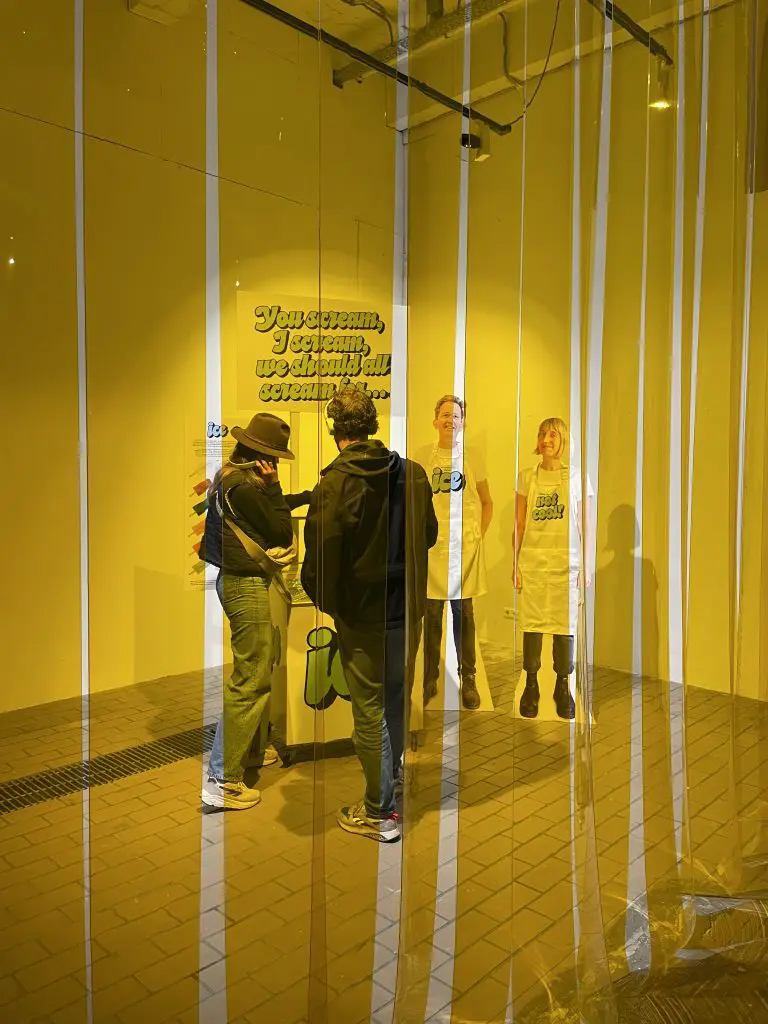


Welcome to the ice™ shop
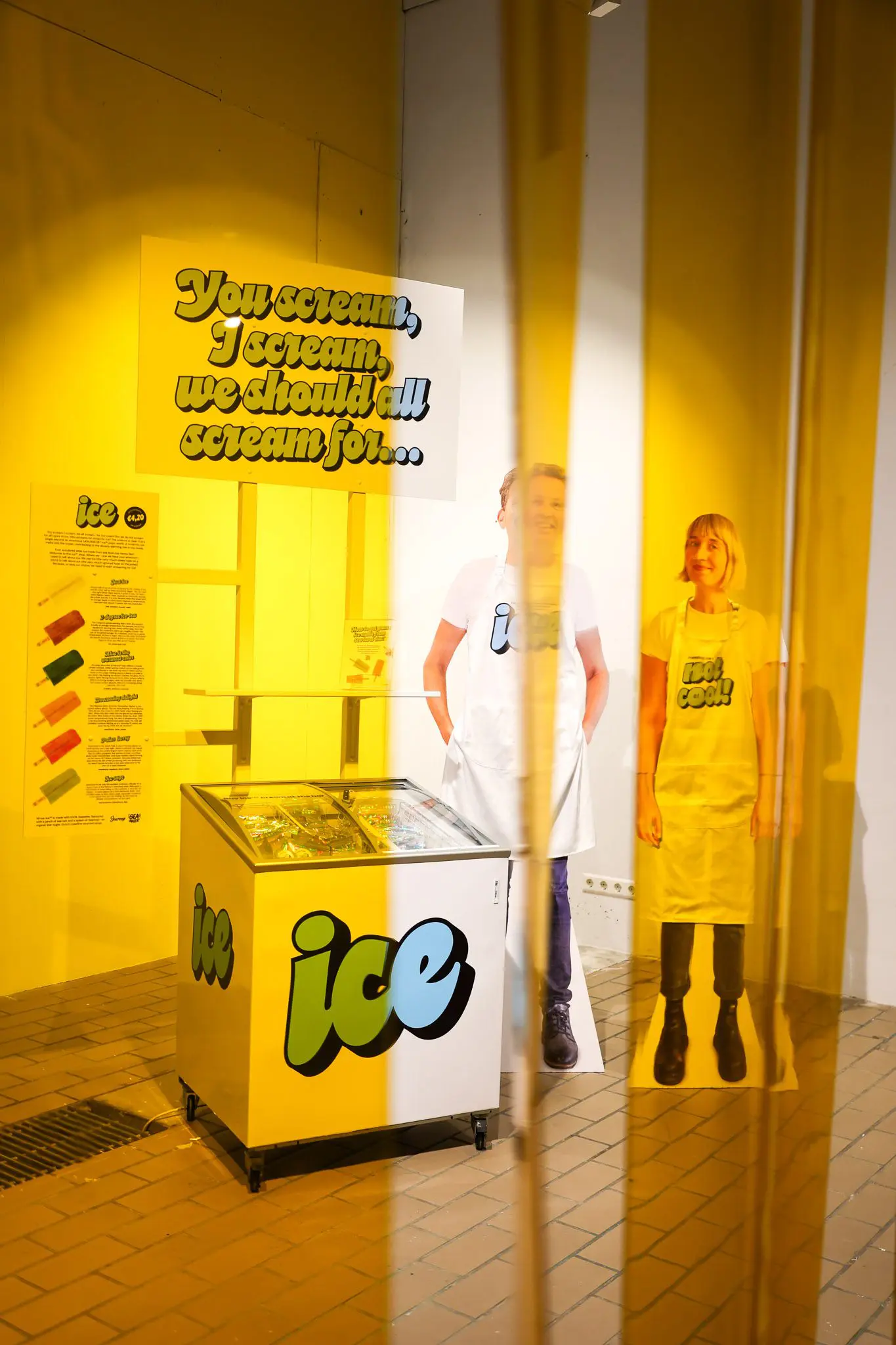
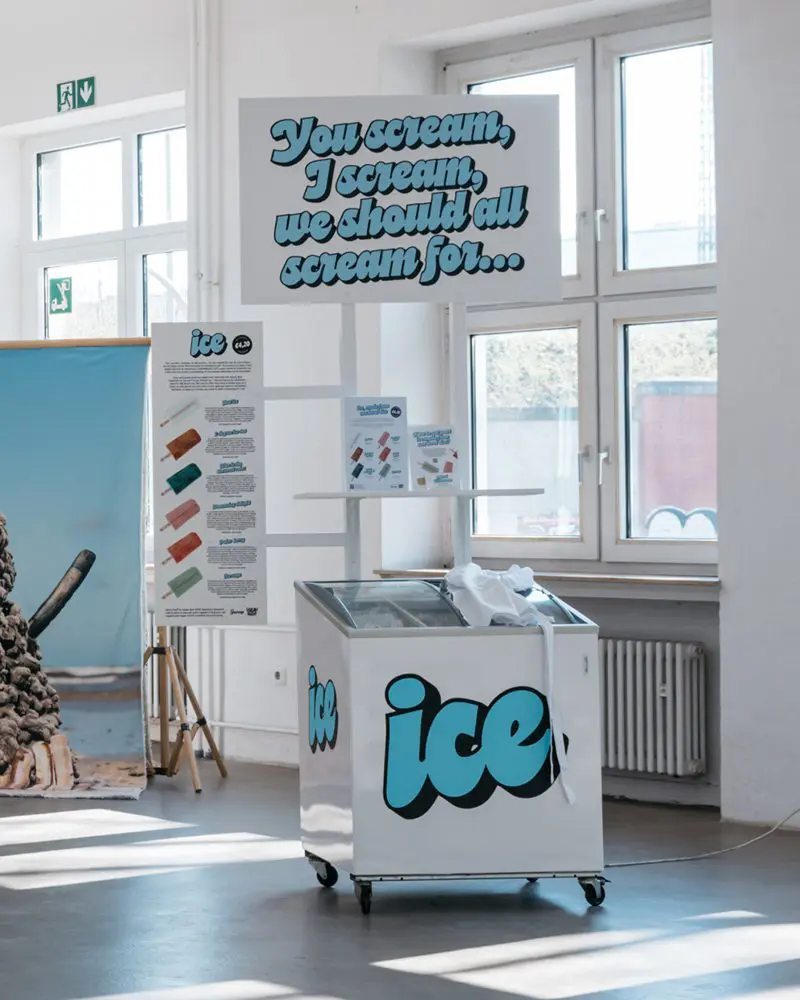
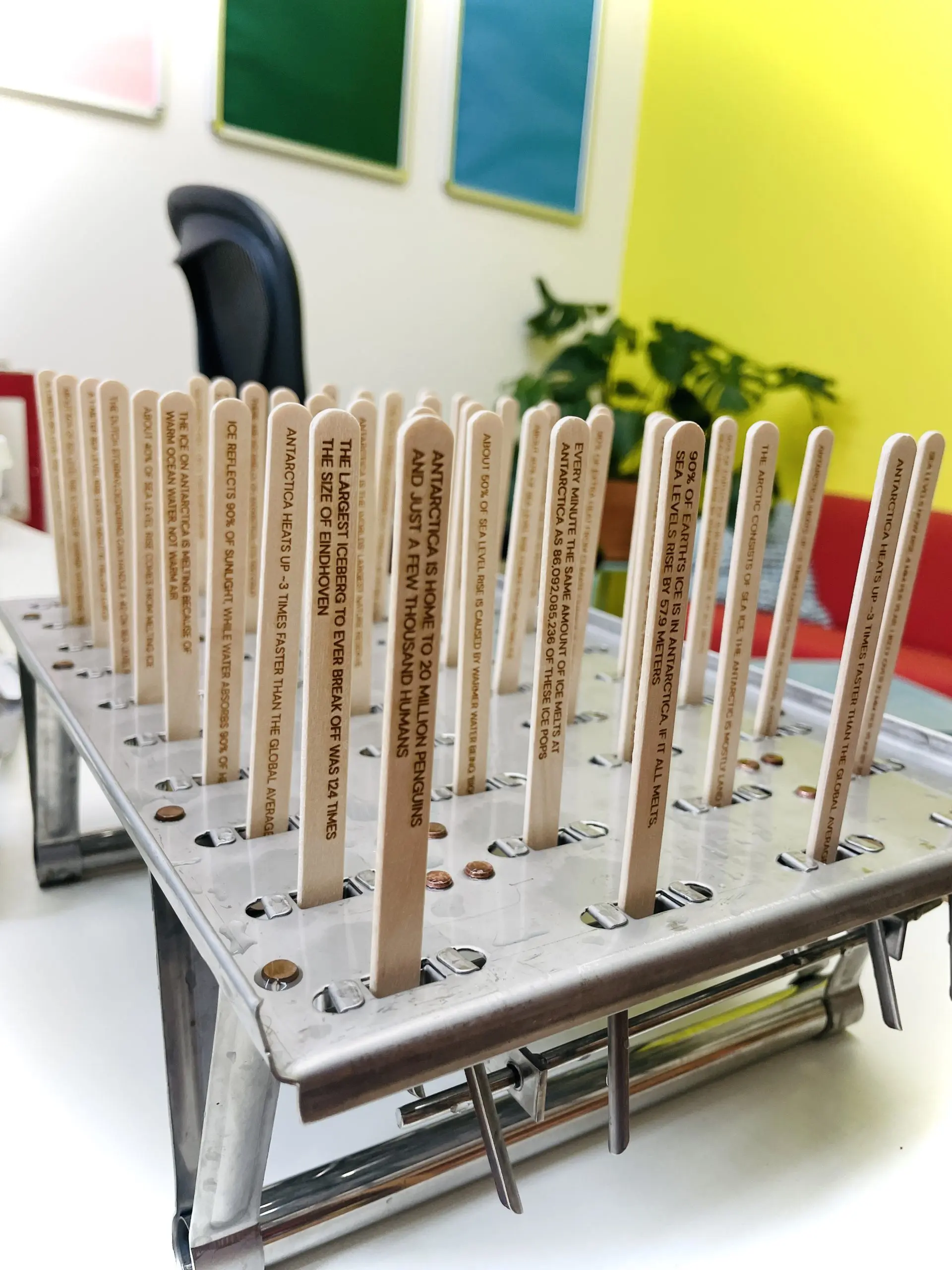
The shop opened for the first time during Dutch Design Week 2024, where six flavours of ice™ were available: each one made from 100% seawater, and named after a different aspect of Antarctic melt dynamics. Every wrapper doubles as a scientific explainer. Every purchase starts a conversation.
The ice™ shop isn’t just for design weeks, sunny beaches and festivals. It belongs at climate summits, conference foyers, and anywhere people need a reason to talk about something they’d rather not think about.



The science behind the ice™
In collaboration with Roderik van der Wal, professor of sea level rise at Utrecht University, I spent months studying melt dynamics of the Antarctic ice sheet, IPCC reports, and cryoscience communities. Roderik is exceptionally good at understanding the problem, but not trained to think towards solutions. Together, we decided to try anyway by starting this sea level neutral geo-engineering business. Because every portion of sea water we freeze, equals less sea level rise (until a person decides to eat the ice… ).


The flavours
The ice shop produces ice in 6 different scientific flavors:

Two degree ice tea
(tea, lemon leaf, mint)
——————————
The 2 degrees global warming that’s often discussed is actually an average temperature. For example, around the equator it’s warming less. Areas further away from the equator, like Antarctica, warm up—roughly 3 times— the rate of the global average. So a relatively small rise in global temperature, will have a larger effect on the poles. And those are exactly the places where all the ice is stored. And what happens when you heat up ice? Exactly…

Blue is the warmest color
(Rhubarb, seafennel, seaweed)
——————————
The deep blue color of this ice™ pop reflects a crucial climate concept. Unlike land ice (which sits on solid ground and contributes to sea level rise when it melts) sea ice floats on the ocean. Melting sea ice is like an ice cube in your drink—the melting ice simply can’t overflow the glass. So no worries, right? Wrong! Because an icy, white surface reflects 90% of incoming sunlight, while the (actually very dark!) blue ocean surface absorbs 90% of it. Increasing global warming… Not cool!

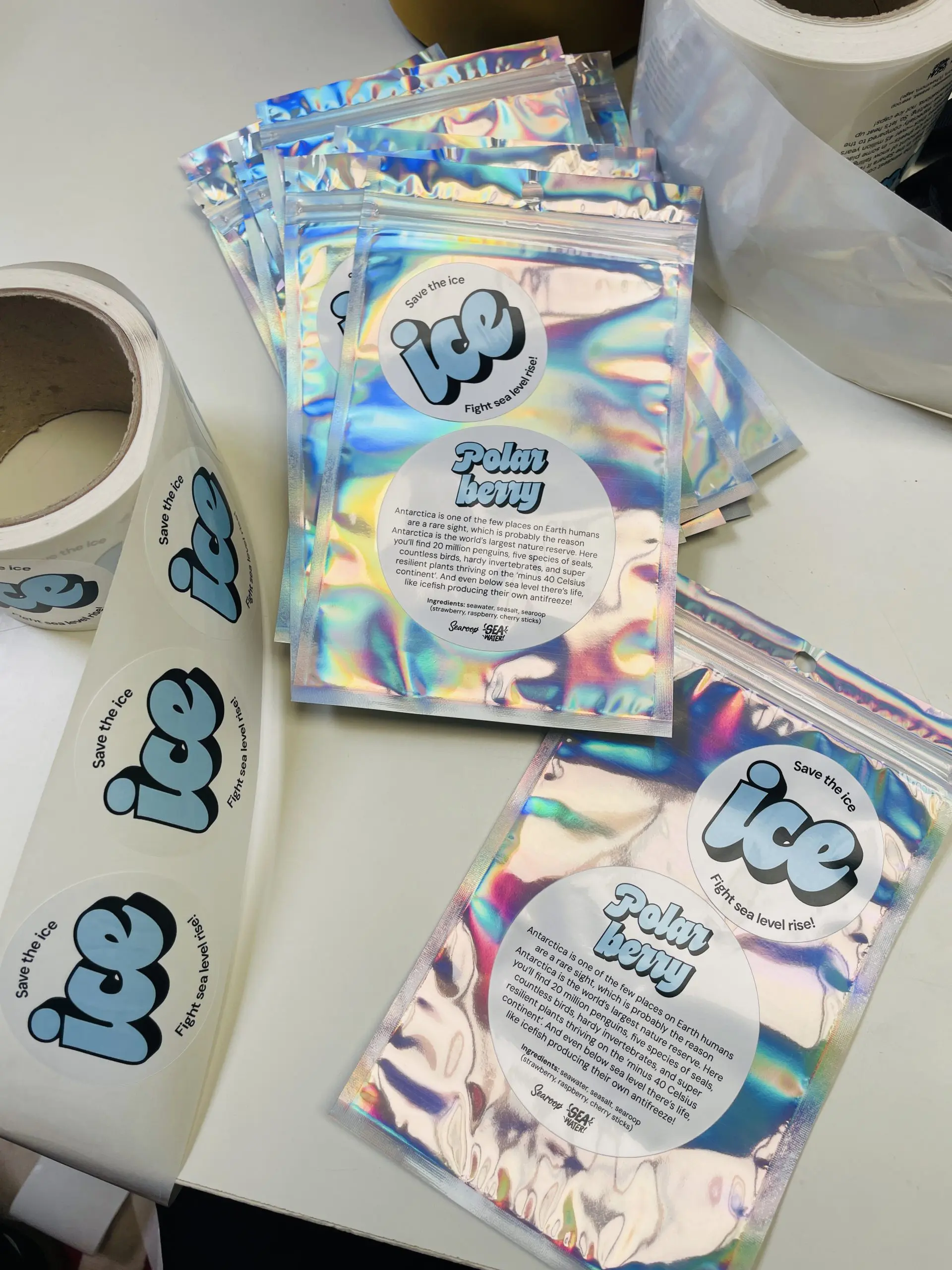
Polar berry
(Strawberry, raspberry, cherry sticks)
——————————
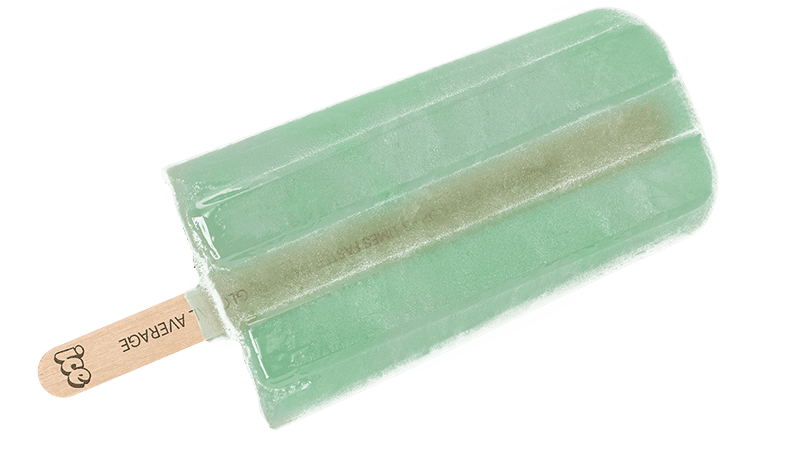
Antarctica is one of the few places on Earth humans are a rare sight, which is probably the reason Antarctica is the world’s largest nature reserve. Here you’ll find 20 million penguins, five species of seals, countless birds, hardy invertebrates, and super resilient plants thriving on the ‘minus 40 Celsius continent’. And even below sea level there’s life, like icefish producing their own antifreeze!
Ice sage
(Sea buckthorn, (t)hawthorn, sage)
——————————
Antarctica is not only the windiest continent, officially it’s a desert. Even in the Sahara, it rains more often. With such a tiny amount of snow falling on the continent, it took the ice sheets— in some places up to four kilometres thick—over 45 million years to form. Quite a wait, especially compared to the speed they are now melting.— So, let’s heat up climate-conversations, not ice caps!

Doomsday delight
(Elderflower, violet, poppy)
——————————
The infamous West Antarctic ‘Doomsday Glacier’ is the world’s widest glacier. The one thing keeping it from flowing directly into the ocean is a 200-meter-thick floating ice ‘dam’. When this dam melts, first the glacier but ultimately the entire West Antarctic ice follows ‘down the drain’. Now, with ocean temperatures rising, these dams are disappearing faster each year. Even if we stop emitting greenhouse gases today, the melt will probably continue, leading up to a stunning 15 meters sea level rise by 2300. Are we doomed?
Just ice
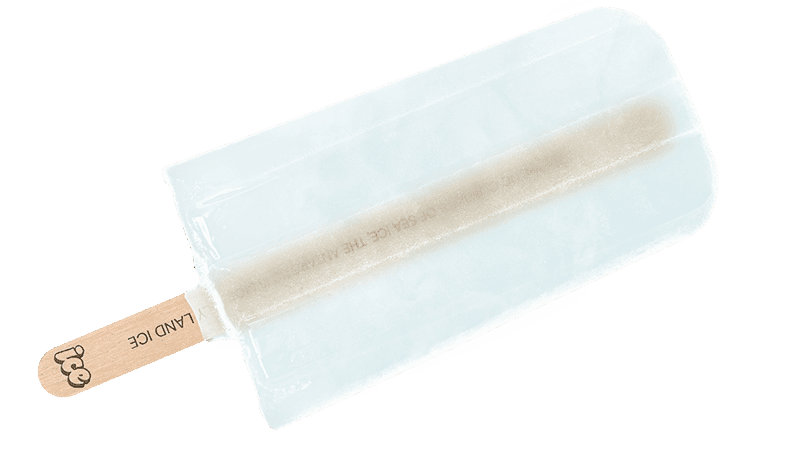
No flavour (just seawater, sea salt)
——————————
Around half of sea level rise is caused by the melting of ice, and the other half by water becoming ‘bigger’. Yes, you read that right! When water warms, it grows in size. For every extra degree Celsius, water expands by 0.00021%. Sounds like a little, actually it is a lot. Because when the ocean (and its average depth of 4 km) rises 2 degrees in temperature, sea level rises almost 2 meters. Bye bye, beach life!
The making of
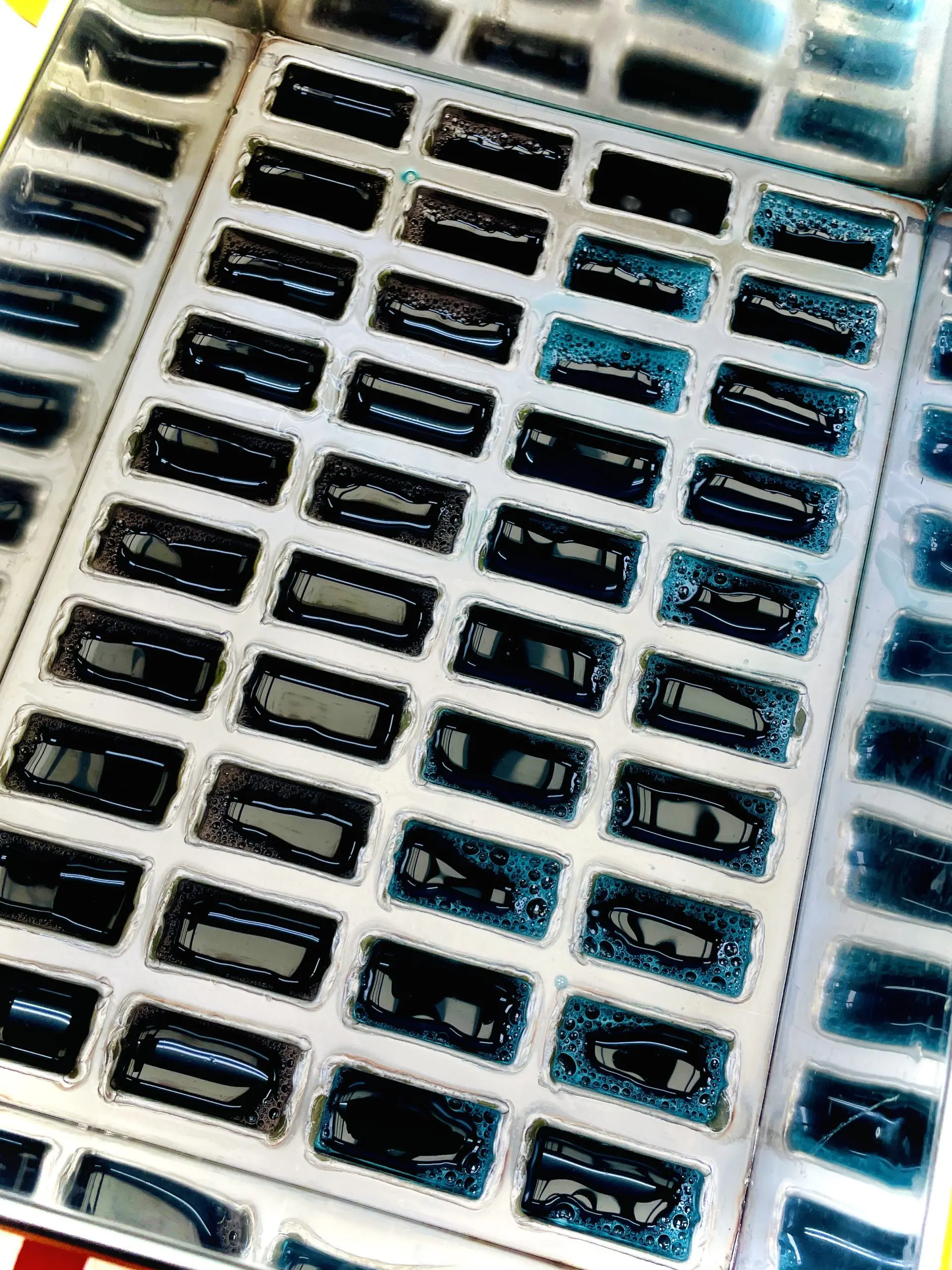
Every sea water ice™pop started as… sea water. Sourced from the North Sea, pumped up, filtered until clean enough to drink (in collaboration with Sea Water). Then the water is flavored with coastal flavors (in collaboration with Searoop), and poured, frozen and wrapped by hand. Each icestick features an unique fact about the Antarctic, and each of the six flavours gets their own wrapper. Each wrapper doubles as a scientific explainer: the science isn’t printed next to the product, it is the packaging.


Hungry for more?
The ice™ shop is available for events, exhibitions, and climate conversations. I also give talks about this project — about the process, the science, and what happens when you hand a climate researcher an ice lolly and ask him to sell it.
Credits
Concept & execution: Merel Witteman
Made in the context of: Collaborations for Future, initiated by Foundation We Are
Exposition: Dutch Design Week 2024, Kunstlerhaus Dortmund 2025
Scientist: Roderik van der Wal, Utrecht University
Copy: Thanks for the help, Rufus Ketting