What if your website had an energy label?
Websites may seem invisible, weightless and just information floating in a cloud. But every click, swipe or play uses data. Transporting, processing and storing that data requires electricity. And as long as that electricity doesn’t come entirely from renewable sources, using the internet produces CO₂ emissions.
The thing is: you can’t see those emissions…
That’s why Carbonfooter makes the invisible footprint of websites visible. Enter any URL on carbonfooter.nl and it calculates the estimated CO₂ emissions of visiting that page.


So, how much CO2 is a lot?
A number like 0.7 grams of CO₂ doesn’t mean much on its own. That’s why carbonfooter puts it into context: how does the page compare to other websites? What if you gave it an energy label? What does that footprint add up to over a year? How does it compare to driving a car or taking a hot shower? And where do most of its emissions come from?
The result is not just a score, but a complete report. It checks things like page size, images, code, fonts, caching and whether the website runs on green energy, and turns those findings into personalised, practical tips for making the page lighter.

What if the footprint was in the footer?
You could of course keep going back to carbonfooter.nl to see how each page of your website is doing after each improvement. Or, the carbon footprint could become part of the website itself. And where better than… in the footer.
The Carbonfooter WordPress plugin calculates the footprint of every page automatically. Behind the scenes, it shows all pages together in one dashboard, making it easy to see which pages are doing well and which could do with some slimming down.
And on the website itself, it does exactly what its name suggests: it puts the carbon footprint in the footer. Visible to all visitors.
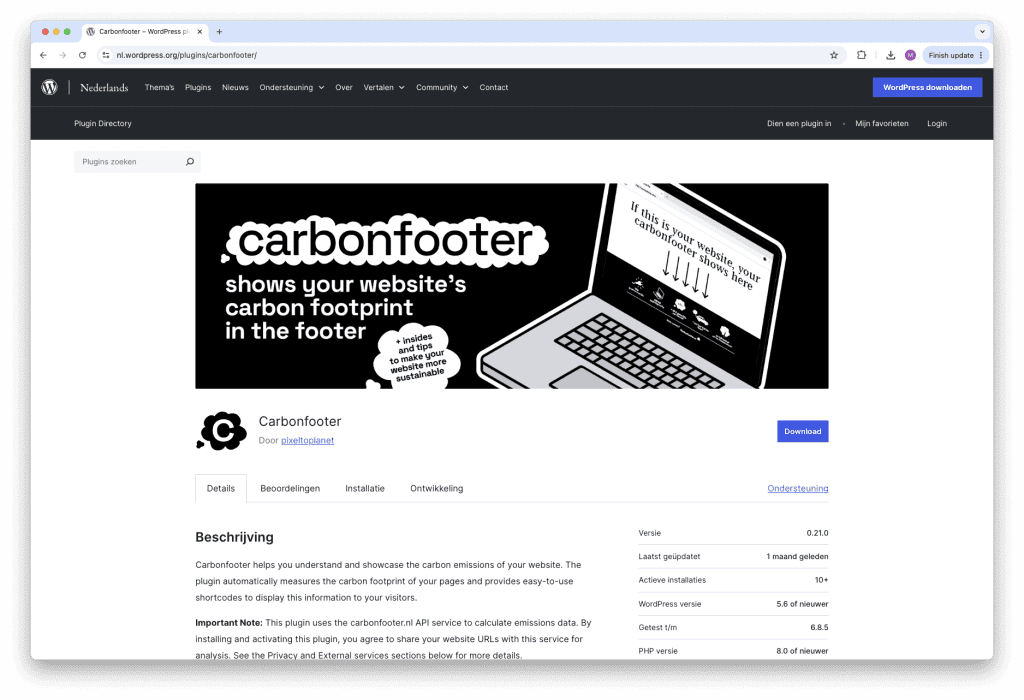
How stinky is your website?
All carbonfooter tools are open source and free to use. So, check your website on carbonfooter.nl or put your website’s carbonfootprint into the footer using our Wordpress Plugin. And see how low you can go!
Credits
Concept & execution: Merel Witteman & Danny Moons (collaborating as Pixel to Planet)
Supported by: Stimuleringsfonds Creatieve Industrie & SIDN Fonds